Tuesday, June 29, 2010
umm....fact check.
So, I was reading people.com and stumbled across Elizabeth Edwards' interview. Apparently her cancer has metastasized more, with tumors in her legs, spine and skull. Breast cancer most often metastasizes to the bones, brain, lungs or liver. But what got me was what she said...."It's less frightening than you think; it can't migrate to your brain." I am hoping she meant literally move from the skull to the brain, because breast cancer can certainly metastasize to your brain. I have had the good fortune to meet this woman, and she is really lovely. She is an amazing woman, and I am sad to hear that she has more bone mets. I actually think she gets treatment here at UNC.

Monday, June 28, 2010
treated to death.
I have talked ad nauseum about hospice, end-of-life care and death with my friend Carolyn, and today I came across an article that was so wonderful. And it talked about many of the things she and I have discussed. Namely, Americans are being treated for incurable cancers til right before they die, rather than having those hard conversations with their doctors and urged to pursue hospice or palliative care. And many of those patients suffer and experience pain, and do not get to live their days out like they would have liked. They cited that 12 percent of patients who died from cancer in 1999 received chemo in the 2 weeks before they died. The article mentioned that Americans use sports and war metaphors in dealing with disease and cancer, instead of talking about death and how it is a natural part of life.
I have seen this myself. I saw how my grandfather was treated, time and time again for his mesothelioma and lung cancer, though we knew it wasn't making much of a difference. He got his chemo treatments, his Procrit, lost a ton of weight, lost his bowels and bladder in public, and in the process, lost his dignity and enjoyment of life. I was living in Florida at the time, and had a feeling he wasn't going to live til Thanksgiving, when I was slated to come up to NJ next, so I flew up Halloween weekend, after not seeing him since July. He was a shell of who he had been. He was just put on hospice, after years of treatment. He could barely eat, could barely drink, could barely breathe. He had moments of lucidity and moments of....well, it wasn't delirium, but it definitely was some sort of supernatural end-of-life thing. We talked about how he was "watching the wind" because he "couldn't go" until it was a certain way. Make of that what you will. It wasn't until he was on hospice that he finally got permission to relax and let go. I left that Sunday to fly back to FL; he died the following Saturday. He was on hospice for little more than a week. This isn't too far from the national average for hospice stays.
He missed so much because he was sick. He was too sick to go to my college graduation. He was in and out of care facilities. The day before I moved to FL, we had to take him to the hospital because his lungs were filling up with fluid. In my heart, I know it could have gone down a totally different way.
So when do doctors, nurses and nurse practitioners talk to their patients? How do we get the point across that palliative and hospice care isn't "giving up"? How do we convey that it's a way for the person to enjoy their life and the time they have left, rather than missing out on family gatherings, Christmas dinners and seeing their grandchildren? How do we admit that the treatment they are on might not be working, or may be of minimal value when compared to the painful side effects? There is no easy way. I know this as someone who has provided counseling to cancer patients, some of whom really needed help talking to their family about death. I know this as a health researcher, a patient advocate and a family member. It is not an easy set of conversations to have, and each person has to make a personal choice that is right for them at that time.
People may see it as "giving up hope", but I don't think it is. I think it is merely a shift in what we are hoping for. Let's hope for days free of crippling fatigue and vomiting. Let's hope for being healthy enough for holidays, or trips to places you've always wanted to go. Let's hope for quality time with loved ones and friends, days where honesty is spoken and we say everything we need to. We can hope for living life, not just prolonging survival.
Saturday, June 26, 2010
KT Tape, where have you been all my life?

Some uses of KT tape.
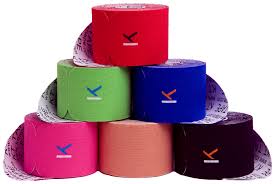
Different colors of KT Tape. I'm partial to pink, myself.

Anyway, this KT Tape is magic. Seriously. And it comes in pink! I apply it to my knee in the prescribed pattern, and it really does alleviate soreness and provide support. I love it.
Saturday, June 19, 2010
learning to walk.
I finally got my air cast off on Monday! I had a feeling I would, and I was planning on going to the gym afterward. At my appointment, the surgeon told me that I was NOT to get on the treadmill and run -- or even walk -- because I could snap the metatarsal, as it is still healing and building bone. Daily activities are fine, but prolonged, excessive walking is not. He said I'll be running by fall, and like a little child, I could feel my eyes tearing up and exclaimed, "But you said I'd be running by July!" He said that in 4 weeks, after my next appointment, we could re-evaluate after looking at new X-rays. So needless to say, I've been continuing swimming, and added biking and the elliptical, as well as upper body weight lifting to my routine.
But there's the little problem of walking. I cannot flex my toes so much; this is normal due to the realigning of the tendons and ligaments. Soft tissue heals much slower than bones, and the nerves are rebuilding themselves. So walking is interesting. I cannot flex my foot and push off the ball of my foot with my left foot. So I end up walking/somewhat limping sort of slowly and overcompensating on my right side. Sometimes it's more pronounced than others, and I get self-conscious about it, because it's not apparent to everyone that I had foot surgery; I just look like I'm walking weird. So I am, essentially, learning to walk all over again. Talk about a metaphor, huh?
In the locker room today, there was a little girl changing next to her mom, and the little girl's locker was next to mine. I had just finished my workout, and the girl started talking to me. She was probably 5 or 6 years old, maybe 7, and she had Down syndrome. She reached into my locker and started playing with the lock, while her mother admonished her and I reassured the mom it was okay for her to touch it. The little girl started telling me about how she's changing back into her clothes because they're going out to dinner, and how much she loves pizza and cookies. I agreed that pizza and cookies sounded pretty good, and I love pizza. I bent down to take my shoes off, and the little girl leaned over so our faces were level and she said to me, smiling, "It's a beautiful day today." The sweetness with which she said it brought tears to my eyes and I said, "Yes, it is." As I was leaving, she called after me, "Have a wonderful summer!" That simple exchange made my day.
Monday, June 7, 2010
Delivering Happiness

Hsieh's Book
Thursday, June 3, 2010
getting in the zone.
Last night was my first UNC Team Wellness multisport club meeting, and the speaker was a sports psychologist. It was a REALLY great meeting, I met new people, and the speaker was amazing. One of the things we talked about was positive self-talk. He said, "There are plenty of people in the world who are willing to beat you up. Don't be one of those people to yourself." And when it came down to it, all of us have doubts. All of us reach that point that our stomachs are churning and we're nervous. Personally, I am nervous every day, with my science classes and training for this thing called a triathlon. I think to myself every single day, in the pool or studying physiology, what the hell am I doing? Why am I doing this? I am terrified. But he said that being scared means you are accepting a challenge, something you've never done before, and that's AWESOME. Give yourself props for accepting a challenge and doing something new. That alone is something to be proud of. Amen, dude.
Granted, this is just a sprint-tri. I'm signing up for the indoor tri in November, and I'd really like to, years down the road, do a half-Ironman or Ironman. I mean, think about it - how amazing is that, to push yourself to the ultimate? Here's a video about it. I thought that everyone would want to do this, but apparently not! I don't know why I'm so intrigued by it, but I am.
Subscribe to:
Posts (Atom)
